
Business insurance refers to financial protection that helps companies cover losses caused by accidents, property damage, legal claims, employee injuries, or operational disruptions. Policies such as general liability, property insurance, workers’ compensation, and professional liability help businesses manage risks that could otherwise threaten operations.
On the question of how much is insurance for a small business or how much is liability insurance for a business, the truth is, it depends. Business insurance pricing largely depends on your industry, business size, coverage requirements, and risks.
The insight into what drives these costs helps you budget better and make reasonable decisions on the level of cover that safeguards your business without spending a lot of money on cover that is unnecessary. More importantly, incorporating insurance planning into your overall financial strategy ensures that premium costs remain manageable and aligned with your cash flow and growth objectives.
What influences the cost of business insurance for a company?
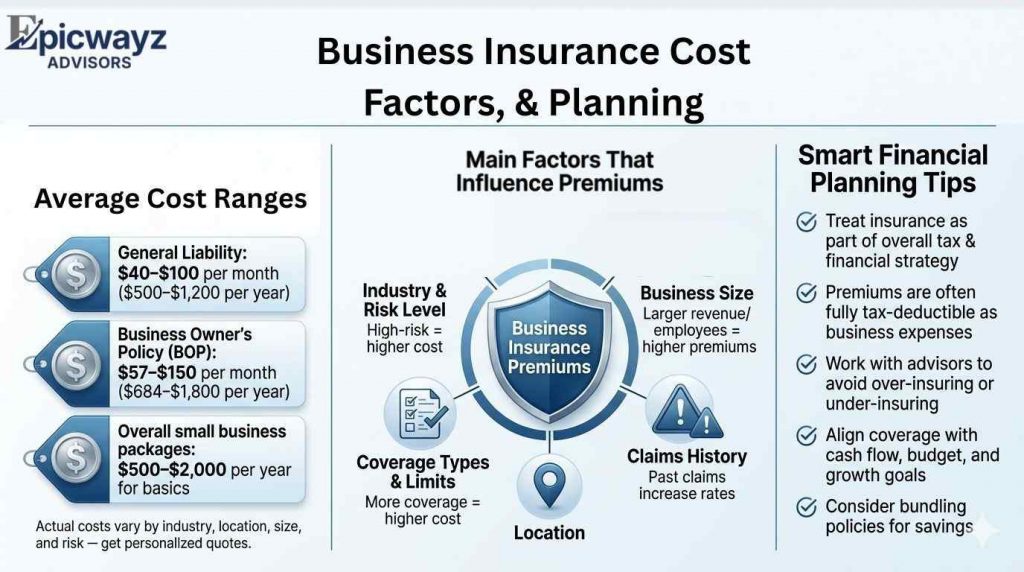
There are various factors that the insurers consider when determining their rates for a business insurance policy. The type of industry is a major determinant of costs because high-risk businesses, such as restaurants, the healthcare industry, construction or manufacturing, incur much higher premiums than low-risk businesses, such as consulting or accounting. The size of the business is also important, and the bigger the business is, the more it pays, as it is more exposed and has more claims.
The types of coverage and limits you choose will have a direct influence on the premiums- a simple general liability is cheaper than full coverage, which includes property damage, professional liability, workers’ compensation, and liability protection, and cyber insurance. To determine how small business insurance fits, it is necessary to consider your own risk profile and coverage requirements.
Business Size, Industry and Risk Level
- Revenue and number of employees: The bigger businesses that have higher revenues and a larger number of employees are more exposed and pay higher premiums.
- Risk classification in industries: Risky industries, such as the construction, restaurant, or healthcare industry, pay much higher than the less risky businesses, such as consulting or technology services.
- Claim history: It is common for businesses that have a history of insurance claims to pay a higher premium when compared to businesses with clean records that show reduced risk.
How can financial and tax advisors help businesses manage insurance costs?
Professional tax and financial advisors assist in optimizing insurance costs through strategic planning and expense management. Tax advisors make sure that you are correctly classifying and claiming insurance premiums as justifiable business expenses and taking advantage of the required expense to the maximum. Financial planning services can identify where you may be over-insured or under-insured so as to align the coverage requirement with the budget.
The services being offered by Epicwayz Advisors in Plano TX, are the fractional CFO services, which are offered on an ongoing basis and provide financial management support that reviews the insurance costs in the entire financial context of the business so that the costs of insurance cover fit into the overall revenue capacity and objectives of the business.
Financial Planning and Cost Forecasting
- Budget integration: There is professional financial planning, which integrates insurance expenses into overall budgets and cash flow projections and allows coverage expenses to create unexpected cash flow issues or necessitate insufficient coverage caused by a lack of proper planning.
- Risk assessment: Business advisory services help assess which insurance coverages will provide the necessary protection and which optional coverages you can skip or reduce based on your current financial status and risk tolerance.
Why is business insurance part of your tax and financial planning strategy?
Insurance is a serious operating cost that directly affects your bottom line and tax position, and it is therefore necessary to incorporate it within an overall financial planning undertaking. In answering the question of “how much does business liability insurance cost”, one has to think not only of the amount paid as a premium but also of its impact on the total expenditure and profitability. Insurance premiums are generally deductible business expenses that lower taxable income and provide tax benefits that partly offset the premium costs.
Combining Risk Management and Tax Strategy
Risk management and tax planning are key components of financial planning practices that treat insurance as a component of overall risk management and tax plans, not a single cost. Professional advisors evaluate the financial basis of self-insurance with increasing deductibles in light of your cash reserves, weighing the bundling policy cost against the total cost, and considering how premium timing can be used to best manage cash flow and tax deductions. The tax and accounting services offered by Epicwayz Advisors ensure that insurance costs are adequately tracked, categorized, and reported in financial statements and tax planning strategies to obtain maximum deductions, while also ensuring that the insurance coverage is appropriate.
What is the role of tax advisors in assisting businesses to select the appropriate insurance cover in terms of finance?
Tax advisors do not sell insurance, but they can offer useful financial insight into decisions insurance agents might not have evaluated when choosing coverage. Professional advisors examine your entire financial situation, including cash flow, profit margins, and growth strategies, to determine the coverage levels your business can absorb and the deductibles that make sense given your cash holdings. They assist in analyzing the cost-benefit of various coverages and the serious protection areas where comprehensive cover has been seen to offer the necessary protection, and where low cover with large deductibles is found to save money without posing unacceptable risk.
Comparison of Coverage and Financial Risk
- Cash flow effect: Tax and financial advisors consider the impact of different insurance premium levels on monthly and annual cash flows, and ensure that the cost of covering cash does not pressure the working capital required to run the business and expand.
- Deductible strategy: Professional advisors help determine the best deductible levels, balancing reduced premiums against potential out-of-pocket expenses if you have a claim, based on your available cash reserves and risk tolerance.

Conclusion
The insurance fees are only a part of business financial planning. We are Epicwayz Advisors, a firm serving Plano and the surrounding communities that offers fractional CFO services, tax services, accounting services, and business advisory services to help business owners understand all of their business’s financials and control every operating cost, such as insurance.