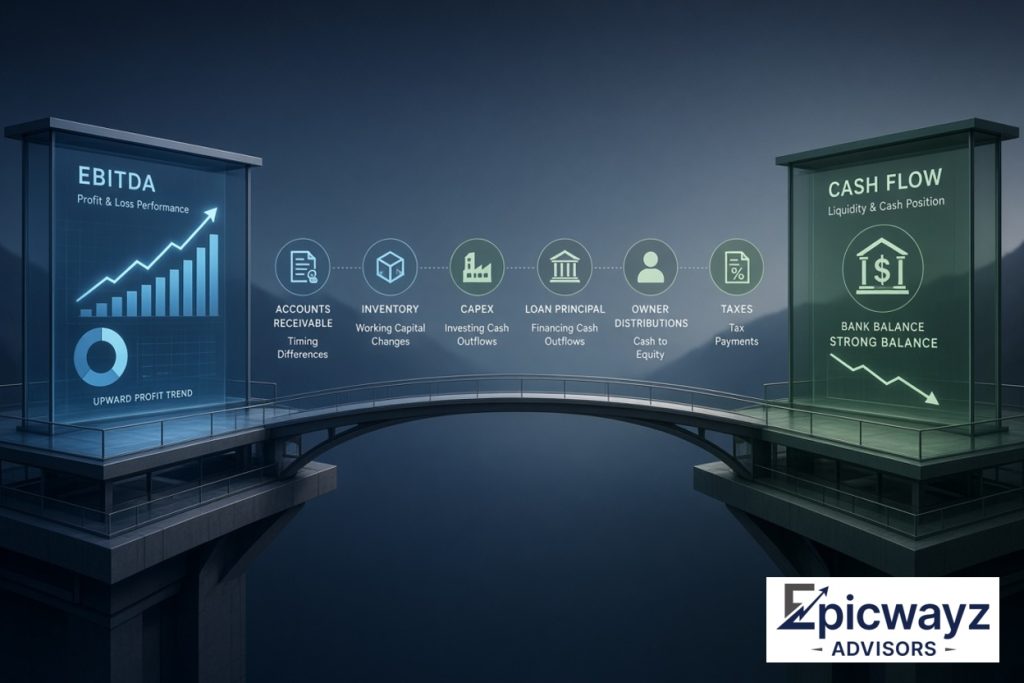

A business can show a profit every month and still run low on cash because EBITDA and cash flow measure two different things. EBITDA is a profit figure calculated before interest, taxes, depreciation, and amortization are subtracted. Cash flow is the actual money moving in and out of the bank account, and it also reflects accounts receivable, debt payments, taxes paid, and capital purchases that never show up on EBITDA at all.
What Is an EBITDA to Cash Flow Bridge?
An EBITDA to cash flow bridge is a simple schedule that starts with EBITDA from the profit and loss statement and walks forward, line by line, to the actual change in the bank balance for the same period. Each line in the bridge represents one real reason the two numbers differ. Owners in Plano, Frisco, McKinney, and across Collin County ask for this most often when their P&L looks healthy but their bank balance tells a tighter story.
Why Doesn’t EBITDA Equal Cash in the Bank?
EBITDA excludes several items that move cash directly. Growing accounts receivable ties up cash in invoices that are earned but not yet collected. A buildup in inventory ties up cash in product sitting on a shelf. Loan principal payments reduce cash but do not appear on the P&L at all, only the interest portion does. Capital expenditures such as equipment or vehicle purchases reduce cash immediately but are depreciated over several years on the P&L. Income taxes and owner distributions also reduce cash without touching EBITDA. Any one of these factors can turn a profitable month into a cash tight month.
How Do You Build a Bridge from EBITDA to Cash?
The bridge is built in a fixed order so nothing gets counted twice.
- Start with EBITDA for the period from the P&L.
- Subtract the increase in accounts receivable, or add back a decrease.
- Subtract the increase in inventory, or add back a decrease.
- Add the increase in accounts payable, or subtract a decrease.
- Subtract capital expenditures made in cash.
- Subtract loan principal payments.
- Subtract cash taxes paid.
- Subtract owner distributions.
The result should equal the actual change in the bank balance for the period. When it does not, that gap points to a bookkeeping error, a timing issue, or a transaction that was missed.
A Real Example from Collin County Advisory Work
One business we currently advise in Collin County looked profitable on the P&L for several months in a row, while its cash position stayed tighter than the profit number suggested it should be. The owner had never had a clear picture of why. Building the EBITDA to cash bridge surfaced two specific gaps. Loan principal payments were reducing cash every month with no effect on EBITDA. Owner distributions were also pulling cash out of the business without touching EBITDA. Adding both items back produced a normalized EBITDA figure, the same number private equity buyers and lenders use to judge a business from the outside. For the first time, the owner could see the business the way an outside buyer would.
When Should a Business Build This Kind of Bridge?
A bridge is worth building any time the P&L and the bank balance seem to disagree. It is also useful before applying for a loan, since lenders in Texas will ask how a growing business is managing working capital. It is useful before bringing on new debt or new equipment, since both change the bridge going forward. It is useful before an ownership transition, since a buyer will want to see cash flow, not just EBITDA. This is exactly the kind of analysis a fractional CFO builds as part of ongoing advisory work, not something a monthly bookkeeping process is set up to produce on its own.
Where This Fits with Amin’s Background
Building this kind of bridge draws directly on management accounting training, which is the focus of the CIMA credential Amin holds alongside his CPA license in Texas and California. It also draws on 20 years of corporate finance experience, including working capital and cash flow analysis at PepsiCo, Colgate Palmolive, and Keurig Dr Pepper, where managing the gap between reported earnings and actual cash was a routine part of the job at a much larger scale than a Collin County small business, but the mechanics are the same.
Questions Business Owners Ask About EBITDA and Cash Flow
Is EBITDA the same thing as cash flow?
No. EBITDA is a profit measure from the P&L. Cash flow is the actual change in the bank account, and it includes items EBITDA leaves out, such as debt principal, capital purchases, and changes in accounts receivable, inventory, and accounts payable.
What is the single biggest reason EBITDA and cash flow diverge for a small business?
For most small businesses in Plano and the surrounding area, growth in accounts receivable is the most common driver. A business that is growing fast often extends more credit to customers, and that credit sits on the books as an asset rather than as cash in hand.
Can my bookkeeper build an EBITDA to cash flow bridge?
A bookkeeper can supply the underlying numbers, accounts receivable, accounts payable, and inventory balances, from the books. Turning those numbers into a bridge and explaining what it means for hiring, financing, or growth decisions is fractional CFO level work, not bookkeeping work.
How often should a growing business review this?
Monthly is ideal for a business that is growing quickly or managing tight cash. Quarterly is a reasonable minimum for a stable business that mainly wants an early warning system.
If your business in Plano, Frisco, McKinney, or elsewhere in Collin County looks profitable but keeps running short on cash, an EBITDA to cash flow bridge is usually the fastest way to find out why. Learn more about Epicwayz fractional CFO services.
Amin Muhammad is the founder of Epicwayz Advisors, a fractional CFO, tax, bookkeeping, and business advisory practice based in Plano, Texas. He is a CPA licensed in Texas and California, holds CIMA, CIA, FCA, and MIT AI credentials, and has more than 20 years of corporate finance experience, including roles at Ernst and Young, PepsiCo, Colgate Palmolive, Keurig Dr Pepper, Core Mark International, and BW Gas and Convenience Holdings. If your numbers do not add up the way they should, schedule a free consultation with Epicwayz Advisors.