
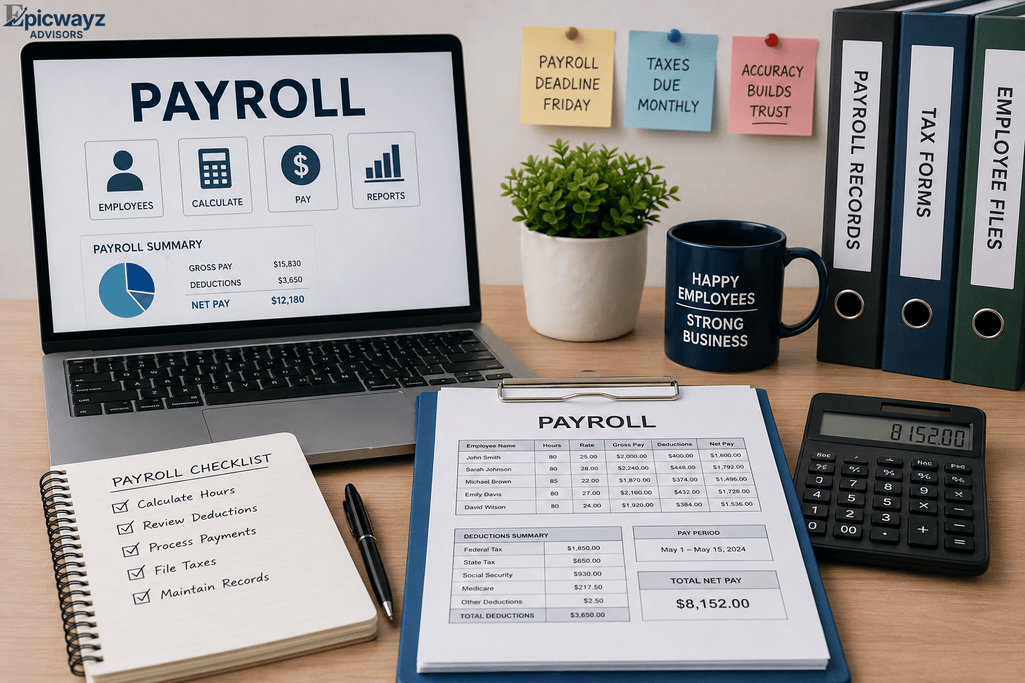

The key to managing payroll in a small business is ensuring that you’re calculating employee pay correctly, withholding the proper taxes, and ensuring all payments and filing are on time all of which saves time, money and compliance stress in the long run. Payroll isn’t simply about paying individuals. It’s a legal and financial obligation, and it has real consequences when done wrong. This guide will take you through the basics of payroll in a step-by-step, easy-to-understand manner, whether you’re a beginner or looking to organize your current payroll system.
What are the essential steps to implement payroll systems for a small business?
Payroll setup for startups: The process of setting up Payroll starts before the first payroll is due. By ensuring that the initial steps are set correctly from the beginning, compliance issues and Common Payroll Mistakes avoid saving businesses money and time later on. The order is important, doing steps out of order leaves holes that are hard to fill and costly to remedy.
Establishing a Payroll Process From the Start
Before running your first payroll, get an IRS Employer Identification Number (EIN), register with your state tax agency, categorize all employees and independent contractors properly, obtain completed IRS W-4 forms from your employees, determine the pay frequency, and use a dependable payroll system.
What is the proper way for a small business owner to figure out how to pay the employee and withhold tax?
Payroll taxes for small businesses boil down to one simple rule: When you pay an employee, you have to calculate their gross pay, deduct the proper federal and state taxes, and pay those taxes to the appropriate tax authorities in a timely fashion. One of the most prevalent payroll errors to avoid and the IRS takes payroll tax compliance seriously — is errors in this process.
Pay and deductions and tax obligations.
- The base used to compute gross pay is really the employees hourly rate or sometimes their salary, you know . Overtime is paid for every hour worked beyond 40 in a week , paid at 1.5 times the hourly rate, in line with federal law , for those hourly employees.
- Now the federal tax withheld is based on the W-4 form plus the IRS withholding tables for each person . Social Security tax at 6.2% and Medicare tax at 1.45% come out of the employee paycheck, and the employer covers that same share too, so the overall FICA contribution lands at 15.3% split right down the middle between employee and employer.
- Taxes are required in both state and local levels but they vary from one place to another . Plano-based businesses typically don’t have to pay state income tax, which makes payroll feel simpler, however the state unemployment tax (SUTA) still applies and it must be worked out and remitted along with the federal unemployment tax (FUTA).
What are the Payroll Records that Small Business Owners should Keep?
One of the most neglected areas of payroll management is recordkeeping, and it’s also one of the most crucial. The IRS and the Department of Labor each have their own guidelines on the length of time you must retain payroll records and what they need to include. Common Payroll Pitfalls to Avoid include not keeping proper records, which can make it difficult for businesses to defend their payroll roles against an audit or compliance exam.
Documentation and Compliance Requirements
- Payroll records for employees should contain all employees’ full names, addresses, Social Security numbers, pay rates, hours worked per pay period, gross pay, all deductions withheld, net pay issued, and pay period dates. IRS records must be kept for a minimum of four years after the tax is due or paid.
- Records of all federal and state tax returns are made of all payroll tax returns, including all federal and state quarterly tax returns (Form 941), all federal and state annual tax returns (Form 940), and all W-2s issued to employees. These documents should be kept and must be coherent with the payroll records kept during the year so as to prevent any discrepancies during the review.
How often should payroll be run for employees?
It’s an essential payroll configuration choice for startups and all businesses, and one that impacts cash flow, employee morale, and tax filing deadlines. Pay frequencies generally include weekly, biweekly, semimonthly and monthly pay. These have varying consequences in terms of administrative burden and tax deposit schedules. For small businesses, the most common option is biweekly payroll, which involves paying workers twice a week or 26 times a year.
- Biweekly payroll, which is paid out twice weekly or 26 times annually, is the most frequent choice for small companies, as it offers a reasonable pay schedule for staff while also being easy to administer. For salaried workforces, semimonthly payroll (24 pay periods) is a good option and makes monthly financial reporting easier.
- Weekly payroll suits industries where payroll hours count vary each week. Weekly payroll suits industries that have different numbers of hours worked in a week. While the easiest to manage, the monthly payroll schedule might not comply with the state’s minimum pay frequency requirements in some jurisdictions, so make sure to check your state’s requirements before choosing a payroll schedule.
For many small business owners, the question of should I outsource payroll, Payroll Taxes Explained for Small Businesses arises and the professional answer is related to the volume, complexity and capacity of your business. If your company is expanding, has several pay types or limited time to manage payroll, outsourcing to a trusted advisory partner can help keep your payroll accurate, compliant and filed on time without completely burdening you as the business owner.

Conclusion
No, payroll is not something you can just ignore, there are consequences when done wrong. Whether it’s setting up payroll for a start-up or maintaining compliance as a growing team, having expert help early on can save businesses from committing the common payroll mistakes to avoid.
Epicwayz Advisors offers Accounting Services, Tax Services, Fractional CFO Services and Business Advisory Services for small businesses in Plano who are seeking professional and reliable support for their payroll and financial needs. Always the better way to go is to consult a licensed professional before payroll issues arise.