
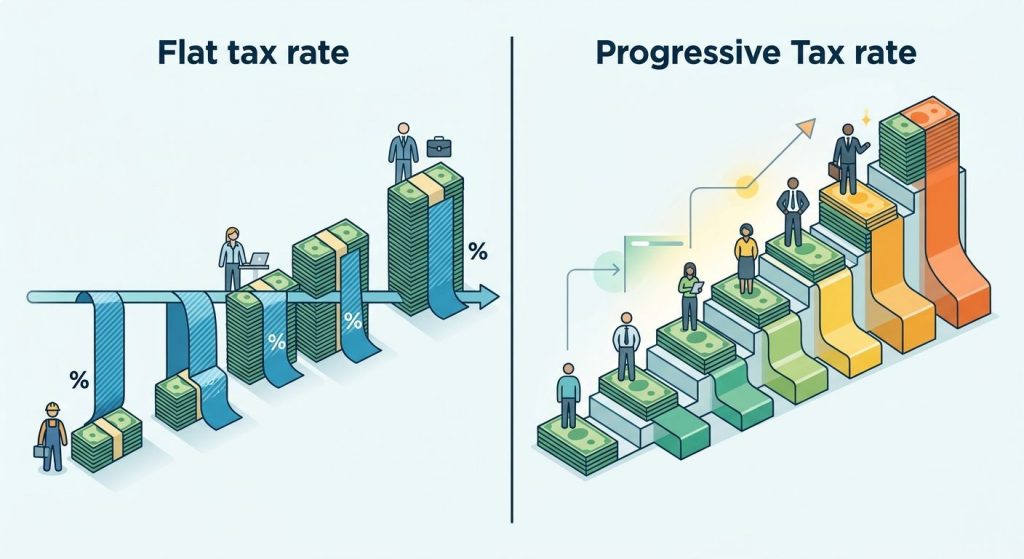

A flat tax rate charges everyone the same percentage of income, no matter how much they earn, while a progressive tax rate charges higher percentages as income increases and honestly, getting this distinction right is one of those useful things a taxpayer can really know. These two foundational kinds of tax systems show up all across the world, and once you see how each one works, it becomes easier to understand your own tax responsibilities, plan more effectively and also make better financial calls during the year. In this blog, the flat tax is explained simply, which helps you understand these complex matters.
The main difference is pretty direct. A flat tax uses one fixed rate on all taxable income no matter if a person makes a little, or a lot, the percentage remains steady. A progressive tax, however, uses escalating rates as income rises. In other words the more you earn the higher the rate that gets applied to each income tier or bracket. The United States federal income tax system is a progressive setup, while certain states , and several other countries use flat tax frameworks.
Basic Definition and Structure Comparison
- Flat tax rate: It’s basically one single percentage that gets applied to every income level in the same manner. A person earning $30,000 and another earning $300,000 pay that same rate and, the only thing that really changes is the dollar amount, based on the income number itself.
- Progressive tax rate: The tax rates go up in steps, also known as brackets. Each bracket covers a certain income band and that band gets taxed at its own specific rate. If your income increases, more of your earnings shift into those higher-rate brackets, and importantly only the portion that lands inside each bracket is taxed at that bracket’s rate.
- Flat tax vs progressive tax examples: Some U.S. states use a flat income tax rate, but the federal government uses a progressive setup, with rates right now roughly around 10% to 37%, depending on taxable income and filing status.
- Types of tax systems seen worldwide include flat, progressive, and regressive structures, each one bringing different results for people, companies, and even how much money the government can raise in revenue
How Does a Flat Tax System Work in Practice?
Flat tax explained simply, you choose one percentage and then you apply it to everyone. If the flat tax rate is 15%, then each taxpayer, no matter their income pays 15% of their taxable income. There are no brackets, no climbing rates, and no worry about “moving” into a higher tax tier after you earn more. This is why some states keep a flat income tax rate, because it feels administratively simple and it’s easier for taxpayers to understand and work out without tangled instructions.
Single Rate Applied to Every Income Level
The main attraction of a flat tax setup is how straightforward it is. There’s one number to remember, one kind of math to do, and usually less bracket confusion. For businesses and self-employed people dealing with uneven earnings during the year, a flat rate can help simplify estimated tax payments, and also smooth financial planning. But, it matters to say this clearly even if a state is flat, federal progressive tax rules still apply, so the real “total tax” picture is rarely as clean as one lone rate, even if your state uses one of these tax systems.
How Does a Progressive Tax System Work for Different Income Brackets?
A progressive tax system divides income into ranges, these are called brackets , and then it uses a separate rate for each portion. The part that a lot of people get wrong, is thinking that if your income goes into a “higher bracket” then everything you earn is automatically taxed at the higher number. It doesn’t work like that. Only the chunk of income that lands inside each bracket gets taxed at that bracket’s rate. And yeah, this is one of the most common mix-ups in personal finance, but once it clicks it makes flat tax vs progressive tax examples way simpler to grasp.
Increasing Tax Rates Based on Income
The U.S. federal progressive tax system right now uses seven brackets. If you’re a single filer, then the first slice of your taxable income is taxed at 10%, the next slice at 12%, and then 22% , and it keeps climbing from there, until it reaches 37% for income above a big cutoff amount. You don’t just jump straight into the top rate on day one, it’s more like you pay the higher rates only on the income that clears each bracket lower limit. So most people, their effective tax rate, meaning the actual slice of total income that ends up in taxes, ends up being lower than the top marginal bracket rate. And honestly knowing that gap matters a lot for sensible money planning, and smoother tax management too.
What Are the Advantages and Disadvantages of a Flat Tax Rate?
Is flat tax better than progressive tax? The real answer is kind of messy but, it depends on your income level, your money goals, and the bigger economic context. Both systems have real upsides and also meaningful downsides.
- Advantage:Simplicity: A flat tax is usually easier to compute, easier to follow, and it cuts down on administrative fuss when people file. That helps both individual taxpayers and companies handling payroll and tax planning, without so many moving parts.
- Advantage: Predictability: With one fixed rate, year round planning feels a bit more direct. You can tell which percentage applies, even if your income swings around.
- Disadvantage: Proportional burden: Critics say the same rate can hit lower-income earners harder in real life, because after the tax is taken out, they have less disposable cash left than higher-income earners do.
- Disadvantage: Revenue implications: Depending on how high or low the flat rate is set, a flat tax model might bring in less total tax revenue compared with a progressive tax setup. That can change how public services run, and it can also influence fiscal policy.

Conclusion
Figuring out the difference between a flat tax rate and a progressive tax rate is sort of core financial literacy, and it really does impact how you plan save, and file. if you are comparing, or picking what system matters most to your situation, it’s smart to work with a licensed tax professional. I always suggest professional help instead of assumptions, because tax law has layers, that general rules and quick advice often miss. Epicwayz Advisors offers Tax Services, Accounting Services, Fractional CFO Services, and Business Advisory Services for individuals and businesses in Plano, for people who want their tax matters handled with careful precision.