
Having a business plan is one of the most significant steps to a successful, sustainable business. Regardless of whether you are creating a small business plan to start a business locally or create a real estate business plan to invest in property, your business plan is your guide that will help you focus on decisions to make, secure funding and focus on long-term growth. Nevertheless, most entrepreneurs develop business plans while only considering the aspects of products and marketing without taking into consideration the important aspects of financial and tax planning, which can either make or break long-term success.
An effective business plan with a real budget and strategic tax planning is indeed a strategic financial forecast that should be incorporated in the business plan. A well-structured business plan typically includes an executive summary, market analysis, financial projections, and a funding strategy. These sections provide a clear overview of the business idea, the target market, expected financial performance, and the capital required to support growth.
What is the best way to develop a business plan with successful tax planning strategies?
It is much cheaper to incorporate tax planning into your business plan early and avoid expensive penalties later as your business expands. Proper tax planning takes into account your business entity, expected income, allowable deductions, and timing strategies that would yield minimal tax liabilities without compromising on any aspect. Certain tax strategies in your business plan need to be specific and industry-based, as well as aligned with your growth plans whether it is a small business plan or a real estate business plan. Timely consideration of taxes enables you to make effective decisions regarding these high costs, the time to hire, equipment acquisition, and when to recognise revenue in a way that maximises your tax position over the year.
Tax Strategy Should Be Part of Business Planning
A thorough business plan will also take into account taxes in all the major decisions, and not consider taxes as an afterthought during the tax season. In devising revenue goals, cost budgets, and developmental investments, consider the impact of these decisions on your tax payment and cash flow.
Establishing Financial and Tax Objectives
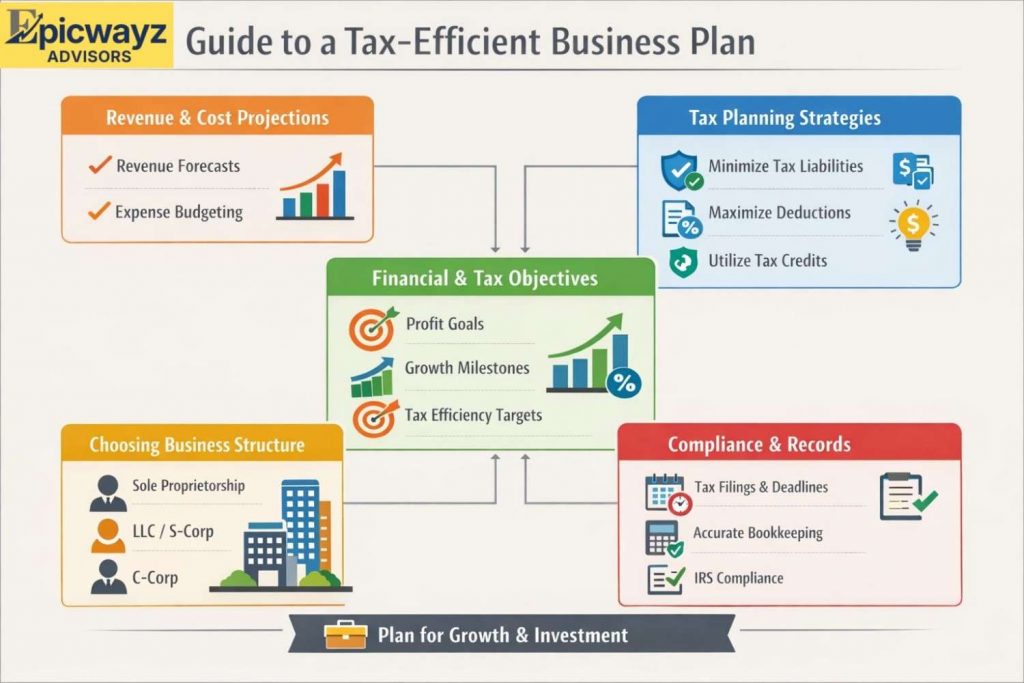
A business plan must set specific financial objectives such as revenue targets, profit margins, and growth milestones, and specific tax efficiency milestones. Establishing certain goals, such as maintaining effective tax rates at specific percentage levels, optimizing deductions on retirement contributions, or timing of income recognition assists in making an operational decision throughout the year.
What are the main financial segments that ought to be included in a business plan that is tax-oriented?
A business plan of a small business or a real estate business plan entails a detailed financial plan in terms of revenue forecast, expenses budget, cash flow, profit, loss forecast, and balance sheet estimates and projected funding requirements over at least a three-year period. Plans that are tax-oriented also include special sections that are concerned with projected tax liability, intended deductions, available tax credits, and compliance mandates. The professional financial modeling must make these projections realistic, interrelated, and based on sound assumptions and not wishful thinking.
Revenue Projections and Cost Estimates
Effective business and tax planning begins and ends with precise forecasting of revenues, and should be based on realistic assumptions regarding market conditions and target customer demand, sales cycles, and growth rates, using industry data and competitive analysis. Cost projections are to be divided into clear categories of costs, the deductible costs, the time at which payment will best position in terms of tax, and how spending timing impacts cash flow and tax position.
Planning and Compliance of Taxes.
- Tax Estimates: Projecting the annual income and determining the estimated quarterly tax payments helps to avoid a surprise at the end of the year and the penalty of underpayments.
- Deduction maximization: As much as possible, discovering valid business expenses that can decrease taxable income without having improper documentation and compliance.
- Tax credit opportunities: Find out what tax credits are available to hire, conduct research and development, make your business energy efficient, or engage in other activities.
- Compliance calendar: Set deadlines with regard to payments of payroll taxes, sales taxes, income taxes, and any other necessary filings that would prevent late penalties.
- Record-keeping systems: Adopting accounting services and bookkeeping procedures that qualify for tax deductions and are able to withstand scrutiny by the IRS.
What implications do you have regarding selecting the appropriate business structure and tax strategy?
The type of business you have, i.e., sole proprietorship, partnership, LLC, S-corporation or C-corporation, is the basic determinant of how your business earnings are taxed and what deductions and strategies can be used. This option is something that must be thought over when creating a business strategy, not thought over on the spur of the moment, in the ignorance of all long-term tax consequences. A business plan for a real estate may have other structure options as compared to a small business plan in either retail or services.
- Sole proprietorship: Easiest form, yet all business revenues are taxed as personal revenues at personal rates – no protection against liabilities or tax versatility.
- Partnership: The income is distributed to personal returns of partners – flexible division of profits, though self-employment taxes are imposed on all earnings.
- LLC: Protection of liability plus flexibility in the taxation – may be taxed as a sole proprietorship, partnership, S-corp, or C-corp based on choices.
- S-Corporation: Pass-through taxation with no double taxation, allowing salary/distribution splits while following IRS reasonable salary rules, which can reduce self-employment taxes.
- C-Corporation: Separate taxable entity with corporate tax rates – may be subjected to dividend taxation twice, but fringe benefit deductions are available in greater amounts.
Strategic Business Planning Provisions.
Most entrepreneurs lack the skill to develop a detailed business plan that involves financial and tax planning that is incorporated in the business plan. You get the benefits of professional fractional CFOs at no full-time CFO price, and you can be confident that your plan is tax-efficient starting day one. The accounting and business advisory services of Epicwayz Advisors would assist in the development of the business plan by offering financial modelling, cash flow forecast, and strategic planning, converting your business dream into a business road map that is realistic and financially viable.

Conclusion
Whether it is a small business plan or a real estate business plan, professional advice is provided so that your business plan is extensive, realistic, and tax efficient. In Epicwayz Advisors, which serves Plano, TX and the surrounding neighborhoods, we are offering the fractional CFO services, tax services, accounting services, and business advisory services that assist business owners in creating data-driven business plans that are tailored to growth and funding goals.