
Payroll deductions are the amounts that get subtracted from an employee’s gross pay before they end up with the paycheck and honestly, getting the basics right here is one of those practical things any person working a job should do, or any business owner should not ignore. If you’ve ever stared at your pay stub and thought why is my take home pay lower than my salary, then this payroll deduction guide is meant to clear that up. This blog walks through how payroll deductions work, what is required by law, and what you can opt into for yourself .
What Are Payroll Deductions and Why Are They Taken From Employee Paychecks?
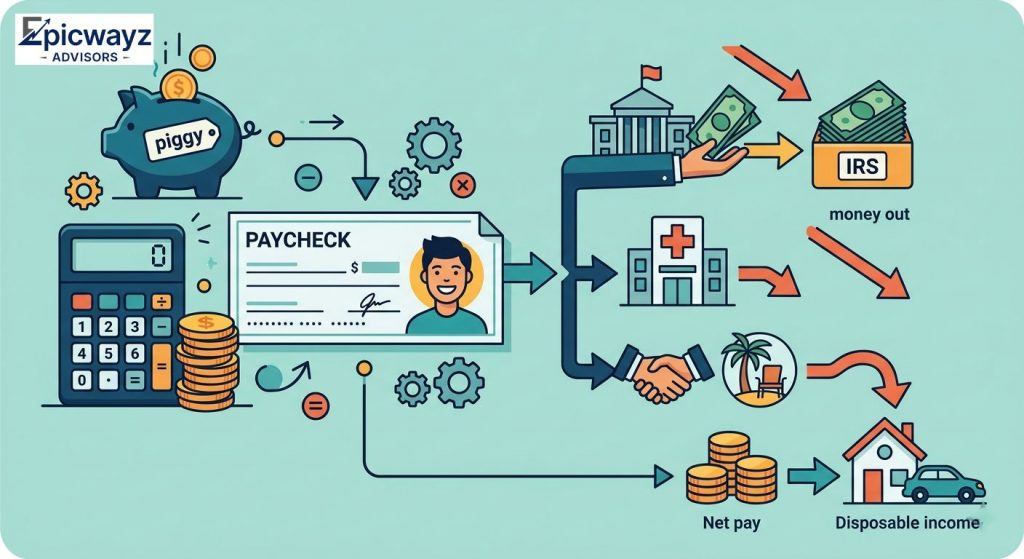
Payroll deductions are amounts removed from an employee’s gross wages before the net pay gets figured out, net pay being the take home number actually deposited or handed over. They exist for a couple of main reasons. Some are legally required contributions to government programs. Others are decided by the employee to help pay for personal benefits like health coverage or retirement savings. When you understand how payroll deductions work, both employees and employers can stay compliant, plan more calmly, and limit those annoying surprises later around tax time. Payroll withholding isn’t random either; each line item on your pay stub has a reason, and also a destination.
What Is the Difference Between Mandatory and Voluntary Payroll Deductions?
Not all deductions are treated the same, really. Some get taken automatically because the law basically says so, and there’s no actual choice involved. Others are picked out by the employee depending on what benefits their employer makes available. Getting a handle on the difference between the two is a real foundational bit in any payroll deduction guide, and it also helps employees make smarter choices about their pay, and the broader benefits package too.
Required Taxes vs. Employee-Elected Benefits
- Mandatory deductions are required by federal , state, or local rules and theyre withheld automatically from any paycheck that qualifies. This usually includes federal income tax, Social Security, Medicare, and any state or local income taxes that apply. Employers don’t get discretion here; those items must be withheld and then remitted to the right government agencies on the proper schedule.
- Voluntary deductions are selected by the employee and authorized in writing, often during onboarding or during an open enrollment period. These include health insurance premium amounts, contributions to retirement accounts, flexible spending accounts, and various other employer-sponsored benefit programs. The goal is often to reduce taxable income, or to provide coverage that the employee actually cares about and will use.
What Payroll Deductions Are Required by Law for Most Employees?
Mandatory payroll withholding covers several categories, and honestly every employee who is subject to it should know what is being taken out, and why. These deductions help fund government programs that provide retirement income , healthcare in later life, unemployment support and also public services. If you know the types of payroll deductions that are legally required, you can read your pay stub more clearly and it also helps employers stay in compliance, on track.
Federal, State, and tax withholdings
- Federal income tax withholding is usually figured using the employee’s gross wages, their filing status, and the details provided on their Form W-4. The amount withheld each pay period goes toward the employee’s annual federal income tax bill, and then it is reconciled when they file their tax return, later on.
- Social Security and Medicare taxes together called FICA taxes are split between the employee and employer. The employee contributes 6.2% of wages toward Social Security and 1.45% toward Medicare, while the employer matches both of those amounts. Some higher earners may also face an extra Medicare surtax , once income goes over specific thresholds, depending on the situation.
State and local income tax withholding can vary a lot based on where the employee lives and works. A few states have no income tax at all, but others use progressive rates that can feel similar to the federal system. Also, in certain places local municipalities may charge their own income taxes, so there can be yet another withholding layer for employees who are affected.
What are some common voluntary payroll deductions offered by employers?
Voluntary deductions are often some of the most useful financial options employees can get, and yet a lot of people just dont use them as well as they could. If you understand what types of payroll deductions are in your benefits package it can cut your taxable income in a real way, help your financial stability, and make your compensation feel bigger than it really is, even though its only your base salary https://epicwayz.com/business-advisory-services/plus benefits.
Health insurance, retirement plans, and other related benefits
- Health insurance premiums are probably the most common voluntary deductions. When an employer provides group health coverage, the employee’s portion of the monthly premium is taken out pre-tax straight from each paycheck , which lowers taxable income while still keeping medical dental , or vision coverage active all year long.
- Retirement plan contributions like 401(k) or 403(b) deferrals let employees route a slice of their pre-tax wages into a retirement account that gets special tax treatment. That means the contributions reduce what you owe now, and they tend to grow on a tax-deferred basis until you withdraw them , so it becomes one of the stronger long-term tools you can set up through payroll.
- Flexible spending accounts and Health Savings Accounts , also called HSAs, let employees stash away pre-tax money for qualified healthcare or dependent care costs. The contributions are removed from gross pay before taxes are calculated, which reduces the overall tax burden while helping with everyday healthcare payments during the year.
Payroll withholding mistakes can lead to penalties, back taxes, and compliance snafus that are costly, and honestly pretty time consuming to fix. This is exactly where some professional support from Epicwayz Advisors comes in and makes a real difference. They are a trusted advisory firm in Plano, and from there Epicwayz Advisors provides Tax Services , Accounting Services, Fractional CFO Services, and Business Advisory Services so business owners and individuals can get the know how needed to manage payroll obligations correctly, fine tune their tax position, and remain fully compliant with federal and state rules.

Conclusion
Payroll deductions are not something you should just skim past , because they influence your take home pay, your tax responsibility, and your longer term financial stability. Whether you are an employee trying to decipher your pay stub, or a business owner coordinating payroll for your group, getting it right really matters. If the details start to feel tangled, get help sooner rather than later. Epicwayz Advisors is here to offer straightforward and dependable guidance across tax, accounting, and business advisory needs, so you can make confident financial choices at each step.